
Poster - ECSSMET 2016 At: Toulouse, France
Ground Testing of Satellite Structures using Optical PM-FBG Sensors to Simultaneously Measure Strain and Temperature
Selwan K Ibrahim, John A O'Dowd, Raymond Mccue, Arthur Honniball, Marting Farnan, Devrez M Karabacak, Jan Van Roosbroeck, Bram Van Hoe, Johan Vlekken, Eric Lindner, Johannes Singer
Short description
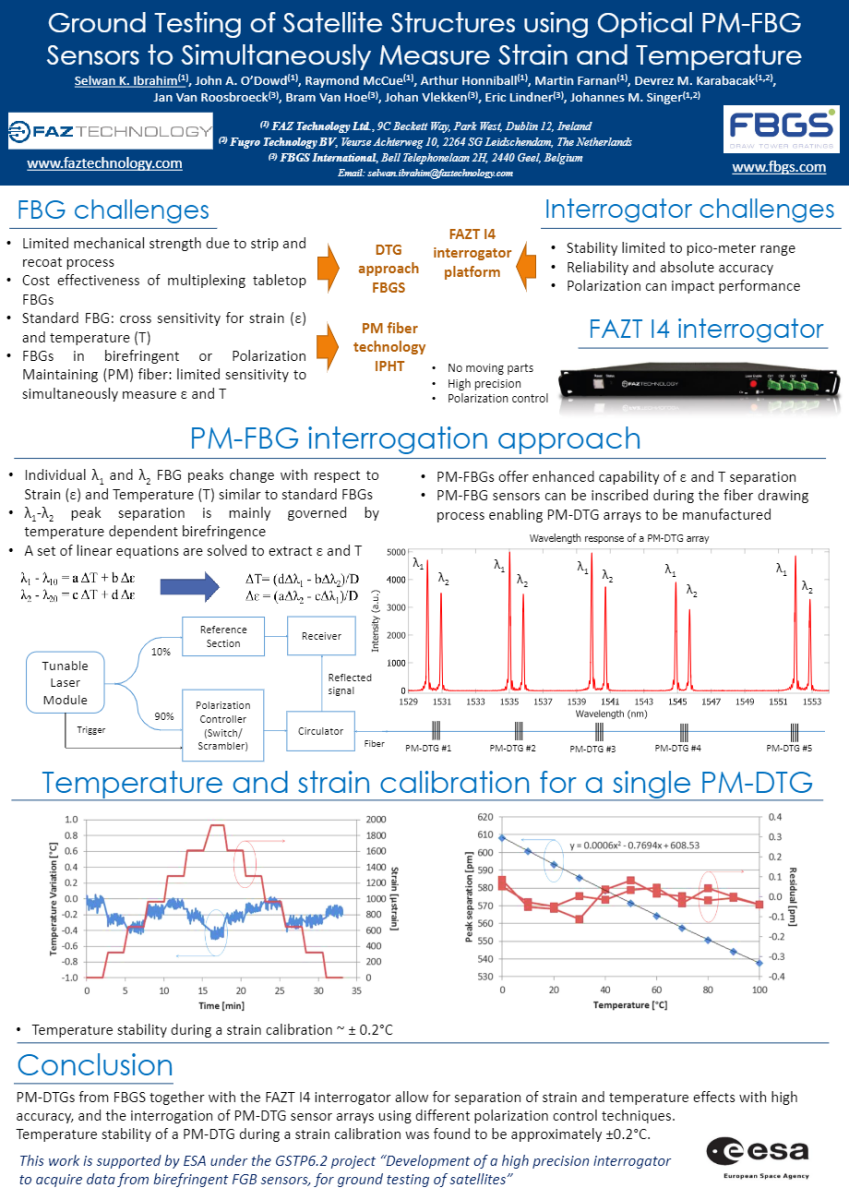
To optimize the prototyping and testing process for satellite structures, sensors are used for ground testing of such structures. This enables the reduction of Assembly Integration and Testing (AIT) time and overall cost which is important for satellite ground testing. Ground testing with high precision measurements enables testing the structure design to achieve optimum performance. Therefore precise sensing technology is necessary for the development of future satellites and is important for the test verification to measure the accurate value of the thermal strain and the micro-vibration which affect the structural stability in space. Conventional methods are based on using electrical sensors, however they are not very efficient when large number of sensors are required and they also suffer from their susceptibility to Electromagnetic interference (EMI). Fiber optic sensors and in particular Fiber Bragg Grating (FBG) based point sensors have been proposed and demonstrated to measure temperature on satellite structures and offer several benefits such as the ease of multiplexing, lightweight, reduction of required cabling and immunity to EMI. However, standard FBG based temperature sensors are sensitive to both strain and temperature and in order to measure temperature, the strain influence has to be isolated from the FBG by careful transducer design, packaging and calibration of the sensor. Also in order to measure both strain and temperature simultaneously, two FBG sensors would be needed which ends up doubling the number of FBGs required on a single fiber. On the other hand birefringent FBGs written on Polarization Maintaining (PM) fiber (PM-FBG) in combination with high precision optical interrogators can offer the same capabilities of standard FBG based optical sensors with high accuracy measurements, and can simultaneously measure both strain and temperature using only one FBG sensor, which enables halving the number of optical FBG sensors required. PM-FBG sensors can also be multiplexed on a single fiber and can offer simplified installation options by mounting them on the surface of the structure without the requirement for re-calibration, and complex transducer packaging designs. Here we propose using PM-FBG technology as a fiber optic sensing solution to simultaneously measure temperature and strain for static and high resolution dynamic applications (Temperature accuracy <0.2ºC, Strain resolution <0.1μɛ), all of which are required for improving the environmental testing and test prediction for ground testing of satellite structures.